

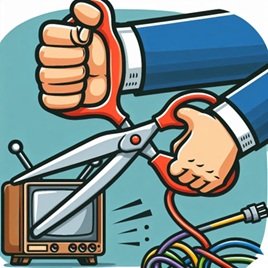
In 2012, the term Cord-Cutting became the popular way to describe the growing number of consumers fleeing the rising costs of their cable-TV subscriptions. Millions left cable companies; however, few disconnected.
2012- 66% of households in the U.S. had a broadband connection.
2024- 93% of households in the U.S. have a broadband connection.
What is a Cord-Cutter?
What does it mean to be a Cord-Cutter? Few have cut the cord, despite many defining it as Cable Television’s ruin. Cord-cutting is the term adopted by the industry to describe rebelling consumers severing their relationship with the Multiple Video Providers (MVP), the traditional Cable Access Television (CATV)
The revolution is over a decade old, and the term Cord-Cutter doesn’t represent consumers’ choices. The industry has tried various descriptions to define this disruption, like Cord-Shaver or Never-Cords. Cord Shavers cut the cable-TV subscription but relied on the cord for internet access and streaming services.
The first generation of Cord-Nevers are the Millennials who moved out of their parent’s homes and chose not to lock themselves into the expensive entertainment services that burden their Boomer parents.
Gen Z is the first generation whose favorite form of entertainment is not television; their focus is more on games or social media.
In 2020 the Direct-to-Consumer revolution began. Analysts predicted streaming video subscriptions in the U.S. would surpass three hundred and eighty-five million.
Even with the dramatic shift in how we consume our entertainment, many households still prefer to watch their favorite films and television on the more prominent and larger LCD screens in the family room.
Still, cord-cutting doesn’t describe the Home Entertainment System’s evolution, because most households that leave their Cable T.V. provider never cut the cord.
Over-the-Top Services OTT: The Evolution of Netflix and Home Streaming.
Netflix started as a DVD subscription service; you paid a specific price for a set number of DVDs to add to your queue.
Netflix’s model caused the downfall of Blockbuster and other DVD/VHS rental stores. Netflix made going to the local rental store and cruising the aisles, trying to figure out what titles your family would enjoy that weekend irrelevant.
To survive, DVD rental stores stocked a plethora of new releases. If you wanted to see that fresh release, there was no way that Netflix could mail those recent releases fast enough.
Redbox, the Netflix Disruptor
Redbox launched as a service that would distribute DVDs through what was candy-machine-like distribution boxes outside your local grocery or drug store.

This was another distribution source for your family’s entertainment experience; it allowed you access to those relevant fresh DVD releases without a subscription plan. And you didn’t have to wait for the following item on your cue to be delivered to your home.
Netflix met Redbox’s challenge by developing an Over-the-Top streaming service that allows users to retrieve DVD titles without relying on snail mail or the limited Redbox inventory.
In the summer of 2024, Redbox declared bankruptcy.
Netflix Streaming on the Frontier
Initially, the limited streaming titles discouraged me, as many of the obscure horror titles I attempted to stream could have been better.
Still, as it matured, Netflix used algorithms to focus on what people were streaming and adjusted their priorities to service what their customers wished to view.
This helped defend against the Redbox users, but it did nothing to differentiate Netflix from the cable offerings they felt they competed with.
Netflix Original Programming
Netflix developed original programming that soon started competing with industry rivals for Emmy and Golden Globe consideration.
This industry recognition led Netflix to invest more in original programming to increase its competitiveness with the traditional production companies for the Emmy stage. The Netflix original series, the House of Cards, won the first Emmy for an OTT service provider. The floodgates opened.
With the traditional sources for industry recognition obliterated, it no longer matters how they delivered your content; it could rise to the peak of recognition no matter what pipes were used to distribute the program.
The Evolution of OTT

A new paradigm began after Netflix challenged the home guard and won with superior content.
The future’s so bright I must find my shades.
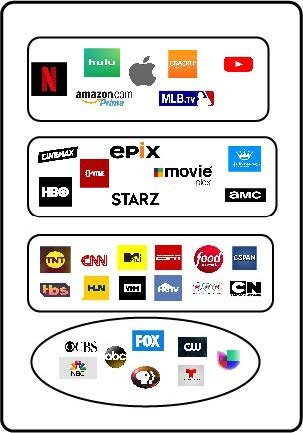
With Netflix’s success, other OTT services, such as Prime Video and Hulu, entered the market and competed for our entertainment experience.
The Grand Buffet of Infinite Content
The pandemic years 2020 to 2022 taught us we could not afford to “Cut the Cord,” but to continue working from home and educating our children, we needed to find the fastest Cord available in our area.
Within that cord is over 300 streaming services, a dizzying amount of content, a literal feast for the eyes.
The goal of The Cord Curator’s Guild is not to teach Cord Cutting, but to help you become a Cord Curator, capable of providing your family with a fulfilling entertainment diet.
Become a guild member and join the curation revolution
Become a guild member and join the curation revolution.
Next Week: We will explore: What Kind of Viewer are you?
How do you and your family consume your favorite content?
TODAY’S QUESTIONS:
How have these changes in technology affected your family?
What choices did you make in how you set up your buffet?
Please share in the comments.

This article contains excerpts from The Cord Curator’s Guide to the Galaxy
eBook Now Available
Paperback Now Available
Leave a Reply